
Why a Master Inspires, but Only a System Can Scale
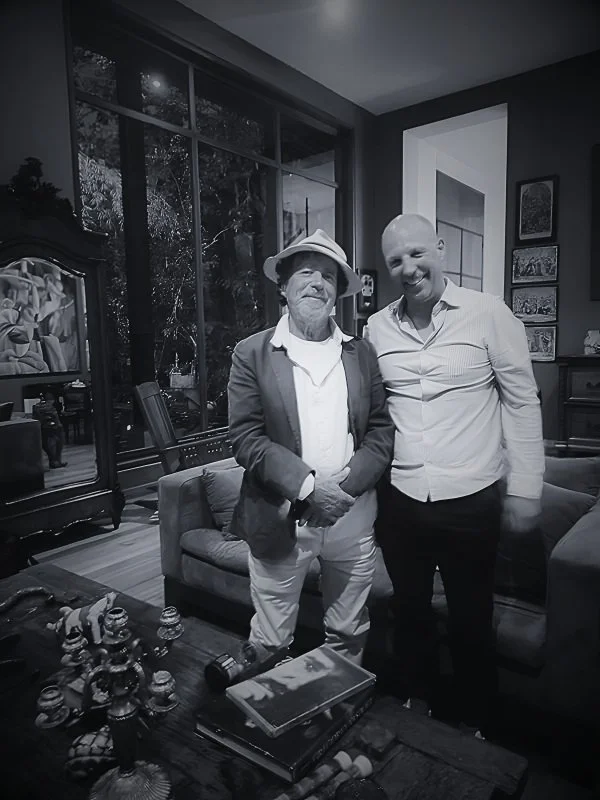
In Bogotá, Openly CEO Andy Keel met with Simón Vélez, the internationally renowned master of bio-based construction. Their conversation lasted late into the night and yielded some inspiring insights, which he shares in this post.
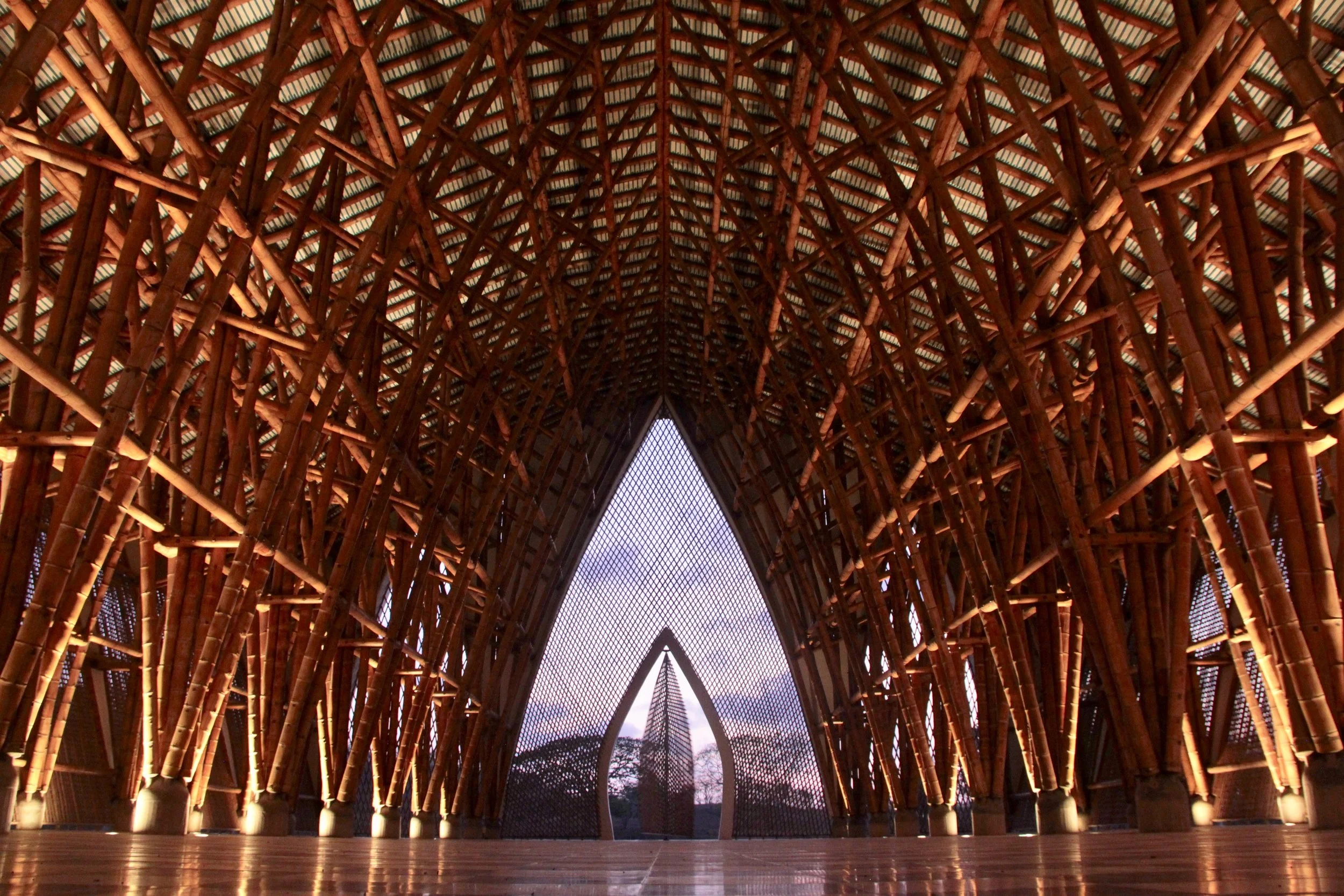
Three-nave bamboo hall in Pereira, Colombia | Photo: Simón Vélez, License: CC BY-SA 4.0.
"I'm sitting on the terrace in Bogotá late at night. The cool mountain air feels good after a day that's still echoing in my mind."
Today I visited Simón Vélez at his home.
When you stand face-to-face with this man, you immediately sense why he is considered the undisputed figurehead of modern bamboo architecture. His work with guadua bamboo is the stuff of legend. But not because he’s riding some trendy wave of sustainability, organic trends, or circularity. Rather, it’s because he has researched, shaped, and understood this material so deeply over the course of 50 years that it has given rise to an architectural DNA entirely of his own—comparable to that of Zaha Hadid. You can recognize a building by Vélez immediately. It doesn’t need a name at the entrance. It’s a statement embodied in a bamboo structural framework.
As we sat there, drinking and talking, he threw out phrases that aren't easily forgotten:
"Start with the roof. Everything else will follow."
"I'd rather work with tradespeople than with engineers."
"I'm a hippie."
"I love Donald Trump."
One might dismiss this as mere posturing. But behind it lies a radical honesty. The material as the absolute starting point. Lived experience that trumps any sterile abstraction. Architecture as an uncompromising, personal expression.
His buildings could never have been conceived on paper as a neutral shell and then clad with just any material. Guadua bamboo does not impose a form on the building—it creates it.
Later, we turned to today’s debate, and Vélez became sharp: We’re throwing bio-based materials, sustainable architecture, and regenerative construction all into the same pot today without a second thought. That’s wrong. A house can be built from a fascinating, renewable raw material without ever having been designed with the goal of healing the climate. Often, outstanding ecological values simply arise as a byproduct of pure passion, craftsmanship, and a spirit of experimentation.
I couldn't help but smile. I had come to exactly the same realization back in 2022, when I spoke with Dietmar Eberle several times about the 2226 concept: Extremely good environmental results can stem from a consistent architectural approach—even if the environmental impact wasn't the original motivation.
I spent a long time today thinking about what this means for us.
At Openly, we take the exact opposite approach. We don’t want to establish a recognizable, signature architectural style. Nor do we want to idolize any single material—such as hemp or wood. And for us, sustainability isn’t just a decorative element that you tack onto a conventional building at the end.
We’ll start with a carefully calculated result: net-zero buildings as scalable and certifiable CO₂ sinks.
Our entire system is based on this principle. Materials, structural engineering, energy, recyclability, and the hard math of finance must all work seamlessly toward this single goal.
To me, the question is clearer than ever tonight: It’s not about whether we can build differently using wood, clay, straw, or bamboo and thereby establish ourselves as environmentally conscious.
The only question that matters is: How can we make regenerative construction economically viable, replicable, and infinitely scalable?
I flew to Colombia to give a keynote speech and search for answers. I’m flying back with a much more pressing question. That’s exactly what happens when you meet people who live by their own uncompromising principles. They don’t validate your path, but they force you to uncover the foundation on which you stand.
"A master like Simón Vélez can inspire the world.
A building system like Openly will change it."
— Andy Keel, Founder & CEO of Openly
The Openly Manifesto here
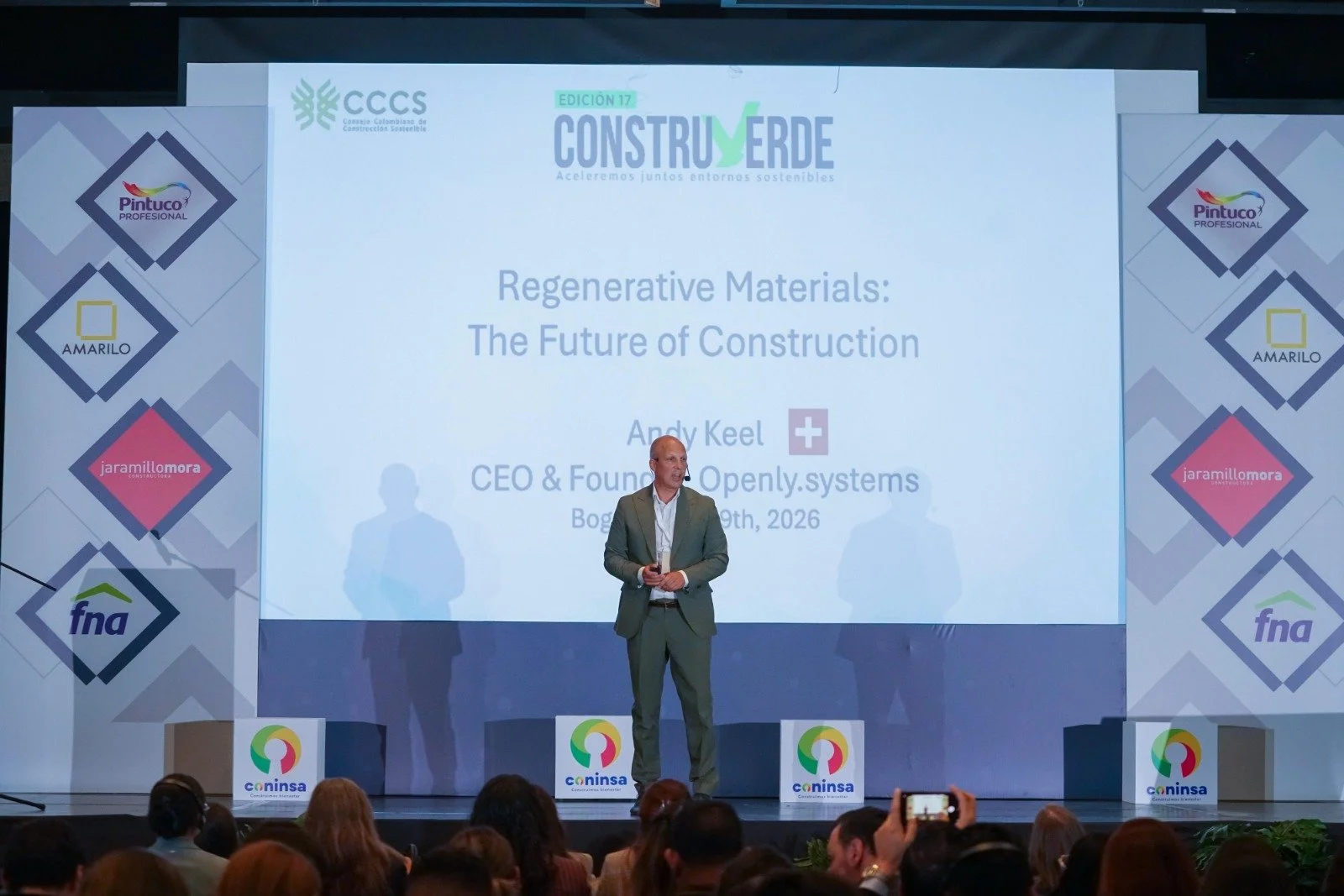
Opening keynote address at the Construverde conference at the invitation of the Green Building Council Latin America (850 attendees, Bogotá).