
When the focus is on sustainability: ESG reporting in Europe and Switzerland
The requirements for companies in the EU and Switzerland with regard to environmental, social, and corporate governance (ESG) are becoming increasingly stringent. From 2025, the Corporate Sustainability Reporting Directive (CSRD) will require large and medium-sized companies to transparently document their CO2 emissions and sustainability strategies. Detailed CO2 balances are crucial in this regard – both for compliance with legal requirements and for strengthening market position.
ESG reporting encompasses not only emissions figures, but also plans for decarbonization by 2030 and 2050. This is becoming increasingly important, particularly in countries with progressive climate legislation such as Germany, France, and Switzerland. This ensures that your company meets the Paris Agreement's 1.5°C targets and is positioned for the future.
The influence of ESG data on a company's creditworthiness
Solid ESG reporting strengthens ratings, financing conditions, and market position. Transparent data and clear reduction targets reduce costs. Incomplete sustainability evidence leads to higher financing costs or rating losses. In addition, more and more customers are demanding complete ESG documentation for their own reporting.
ESG2GO Sustainability is becoming mandatory. Use this to your advantage.
ESG reporting is no longer just a corporate issue—it affects every SME in the supply chain. The good news is that you are already doing a lot of it. Now you need to structure it.
Better credit terms
Banks and investors evaluate ESG data when assessing risk. Transparency = more favorable financing.
Supply chain pressure
Major customers require ESG certification from suppliers for their own reporting purposes. No data, no order.
Regulation is coming
CSRD, EU taxonomy, and EPBD tighten obligations—also indirectly for SMEs.
competitive advantage
Those who start now are positioning themselves. ESG is not just a requirement—it's a differentiator.
Analysis & Goal Definition
Rough assessment: What is your company already doing? Where are the gaps? Set goals.
Process & Responsibilities
Workshop: Defining clear responsibilities, integrating ESG into existing processes.
Tool-supported reporting
With esg2go: SME-compatible rating according to recognized standards. Use KPIs from existing ERP.
Communicate in an audit-ready manner
Transparent reporting—externally verifiable. For procurement processes, customers, and investors.
Interview with Christoph Neururer: How Openly supports reporting

Dr. Christoph Neururer, an expert in sustainable building materials, earned his doctorate in environmental and resource management at the University of Natural Resources and Life Sciences in Vienna.
Since 2025, he has been leading the team for certifications and CO2 balances at Openly. He is an accredited EU taxonomy advisor, DNGB, ÖGNI, and SGNI auditor, and is listed as a professional on the SME platform esg2go.
Christoph.Neuruer@openly.systems / +41 78 258 52 37
Christoph, how important is ESG reporting in construction projects?
CN: ESG reporting is now essential for almost every company, including construction projects. It builds trust among investors and shows how construction projects contribute to CO2 reduction. Accurate CO2 balances are a prerequisite for transparent reporting. We are convinced that the preparation of a CO2 balance sheet will soon become standard for every construction project, regardless of its size, not only in countries with already established CO2 limits in building regulations, such as France or Denmark. Under the EU taxonomy, there is already a disclosure requirement for CO2 balances in new buildings. With the revised Energy Performance of Buildings Directive (EPBD), a CO2 balance will gradually become mandatory for all new buildings by 2030. Limits are also expected to be introduced in order to obtain a building permit. Builders should therefore address this issue at an early stage.
What does Openly offer in this area?
CN: We advise companies on how they can build in a climate-friendly way using the Openly building system and biogenic building materials. Our open, flexible building system with biogenic building materials acts as a CO2 sink. We are also project developers. Based on our experience, we have developed a new standard with CSI that externally and auditably validates the C sink performance, i.e., the CO2 stored in buildings made of biogenic building materials.
The certificates can be used for a company's own ESG reporting or sold. This is exciting for companies that are not only aiming to avoid CO2 emissions and thus reduce their CO2 emissions, but also have their sights set on building up negative emissions (removals) in order to offset CO2 emissions that are difficult or impossible to avoid.
In addition to our services as a C-sink manager, which include the creation of project-specific CO2 balances and the validation of C-sinks, we show construction companies how they can implement an ESG system. In addition to the already established building labels, the sustainability concepts of contractors and subcontractors are increasingly being queried and incorporated into the evaluation matrix as part of the award process. Here we see that the commitments of large companies are gradually impacting the supply chain.
What are the advantages of working with Openly?
CN: In addition to meeting legal requirements, sustainable construction increases the market value of a building. As regulations become increasingly stringent, it is important to address this issue at an early stage. We focus on practical ESG implementation. As construction professionals, we understand the challenges involved in the initial stages. This makes sustainability measurable and economically attractive. Our consulting services provide clarity and certainty in the complex ESG environment.
We are already supporting a medium-sized company in the Rhine Valley with regard to ESG. As a first step, we worked with the management team to conduct a rough analysis of the company and its specific needs, and to set objectives for a comprehensive sustainability concept. In the next step, we held an initial workshop to define a structured process with clear responsibilities and move on to practical implementation. A professional reporting tool designed specifically for SMEs (esg2go) ensures a clear and comprehensible rating. It also supports the entire process, enabling targeted action within recognized standards. Furthermore, it enables the entire reporting process to be presented transparently for an external audit. The existing ERP infrastructure is used for the relevant KPIs—especially in the environmental area—and for internal controlling. This enables the smooth integration of ESG reporting into ongoing business activities.
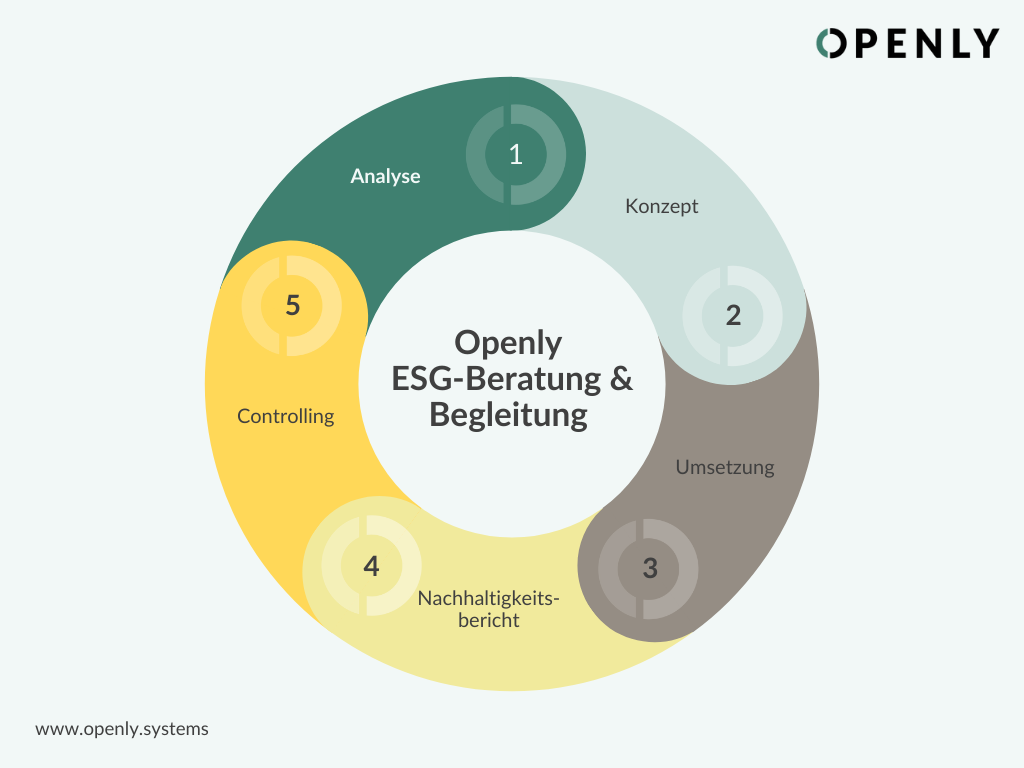
Process: How Openly ESG consulting and support works
One final question—what have you learned from this ESG consultation?
CN: It was exciting to see that the company already covers many ESG topics and has implemented numerous optimization measures in recent years. However, there was a lack of a summarized and structured form for external communication; this can now be done in accordance with recognized standards using ESG reporting.

Rely on Openly for practical ESG implementation. Our consulting services provide clarity and certainty in the complex ESG environment.